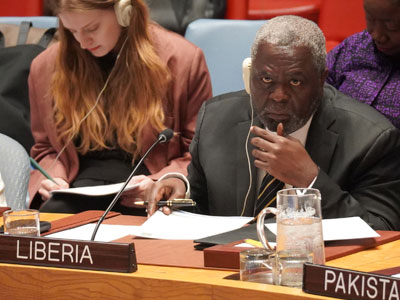
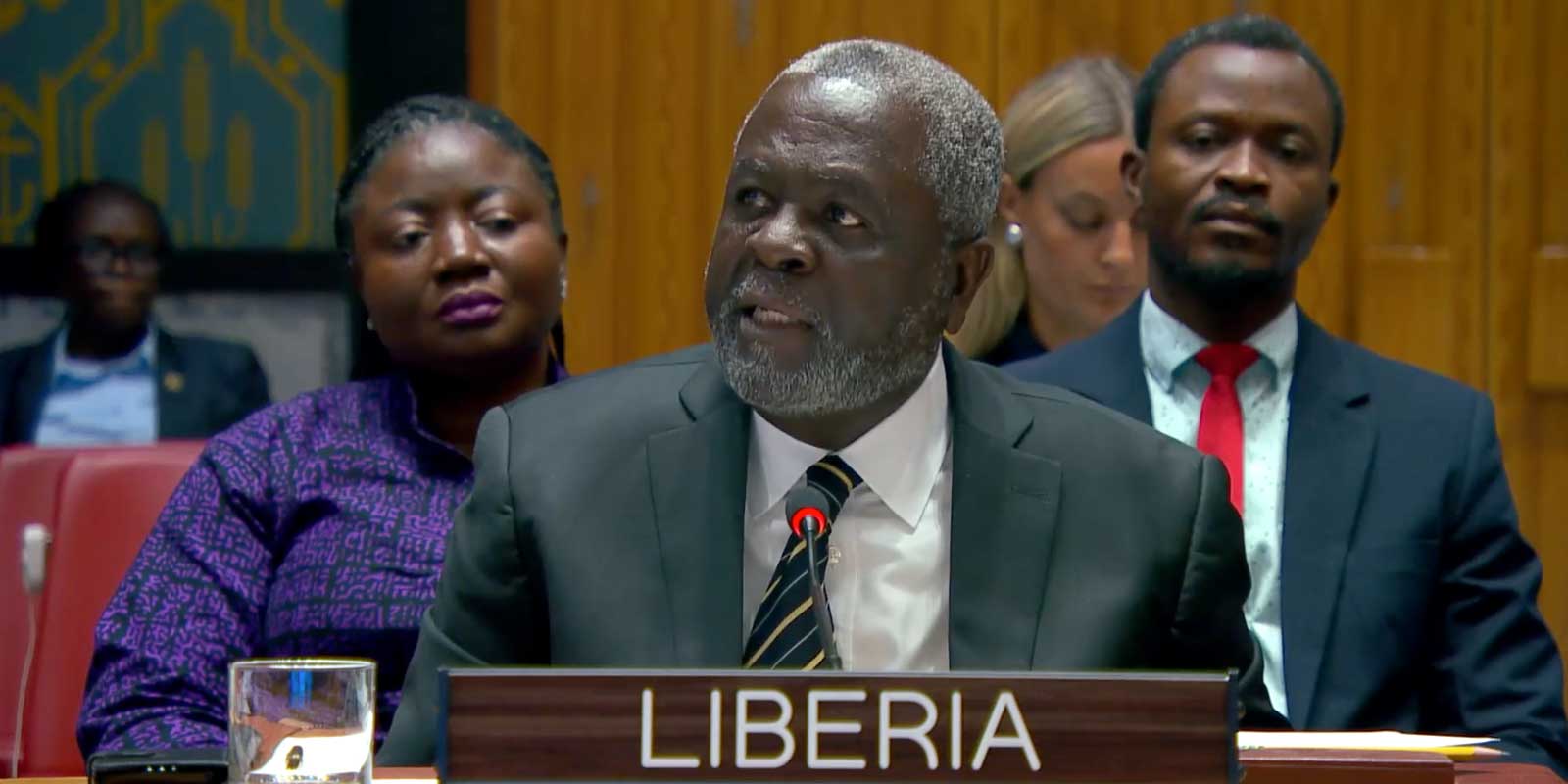
Statement on "Women, Peace and Security", as delivered by Permanent Representative H.E. Amb. Lewis G. Brown, II, at the 10175th meeting of the UN Security Council held on Wednesday, June 17, 2026
Thank you, Madam President.
We join in welcoming your excellency to the chamber and to preside over this important debate.
Liberia thanks Colombia for convening this debate and the briefers for their invaluable insights.
Today, Your Excellency, we wish to testify. Liberia's peace was built by women, including Madame Leymah Gbowee, of whom Liberia is so proud, along with others who refused to be spectators to their own suffering. Their courage helped to end our war, made the peace process both successful and enduring, and has changed our country sustainably for the better.
The evidence concerning women, peace and security, truly, condemns us. In 2024, 676 million women and girls lived within 50 kilometers of deadly conflict, the highest number since the 1990s.
According to the Secretary-General's 2026 report, documented conflict related sexual violence rose sharply from 2024, marked by extreme brutality and overwhelmingly targeted women and girls. It warns that conflict related sexual violence is escalating at scale and brutality across multiple conflicts. While funding courts, impunity and shrinking protection systems are leaving survivors increasingly vulnerable and without access to justice or essential services.
Yet, as already noted by previous speakers, women represented only 7% of negotiators and nearly 9 out of 10 peace negotiation tracks included no woman negotiator. While global military spending exceeded $2.7 trillion, women's organisations in conflict related settings receive just 0.4% of international aid. This imbalance is stark. Resources continue to flow to war while investments in peace building remain severely underfunded.
This is a choice. The exclusion of women is not an oversight to be corrected by better data. It is a power arrangement to be challenged like the women of Liberia did, by courage and political will. Liberia therefore calls on this Council and all member states to do three things:
First, we must implement what we have promised. Resolutions 1325; 1820; 1888; 1960; 2106; and 2467 are obligations not, as we tend to treat them, aspirational literature. The Secretary-General's Common Pledge on Women's Participation has 37 signatories when it should really be 193.
Second, we must fund what we claim to value. Women's organizations in conflict zones must receive at least 1% of bilateral aid—the Secretary-General has asked for no less.
Third, as this institution turns 80, we must protect what a generation fought, including giving their lives to build. The UN80 process must not dismantle gender equality commitments under the cover of austerity. Reforms that silence women are retreats to a dark past in the history of mankind.
Madam President, in Liberia, women did not wait for a seat at the table. Led by Madam Gbowee and others, they built a different table. They crossed battle lines in white T-shirts, sat between warlords and held the silence until the guns inevitably followed.
From that crucible came Africa's first female to be elected democratically head of state of Liberia. This was not a symbol. It was a consequence of trusting women as true agents of transformation. In Liberia, Madam President, women's leadership did not end when the guns fell silent. It shaped what came after. Of the nine commissioners on Liberia's Truth and Reconciliation Commission, four were women, including its Vice Chair. Their presence helped the Commission do something most truth processes failed to do. Nearly half of all statements gathered came from women because women trusted other women to hear what had happened to them during the war. Also, in our disarmament and reintegration program, more than 22,000 women came forward to disarm roughly one in five of all ex combatants only after the process was redesigned to make room for them.
Transitional justice and reintegration are not the postscript to peace negotiations. They are where inclusion is tested at scale long after the cameras have left the negotiating room.
Madam President, Liberia also understands the participation of women without accountability creates an incomplete process. It tells women, wrongly, that their testimony matters, but their remedy can wait. A Council that wants peace processes to include women must also insist that the justice and reparations that follow inclusion be delivered, not merely documented.
This Council endorses peace processes and gives them international legitimacy. That is our greatest point of leverage, which must not be squandered. Therefore, Liberia calls on this Council to adopt a standing practice. Before it endorses, extends or lends authority to any peace process, it should conduct a gender participation assessment, not a new Resolution, not a new body. A decision made here that no process receives the Council's blessing while women remain locked out of it. Applied consistently, this will change negotiating rooms more than another decade of declarations we will make. The architecture of accountability exists. What is needed by all of us is the will to use it.
In conclusion, Madam President, we do not ask this Council to believe Liberia. We ask it to believe its own resolutions, its own data and the testimony of every country made stronger because women led the way out of the war. A peace built without women is only a pause in violence. A peace built with women is a foundation for sustainable justice, reconciliation and lasting security as we are trying to achieve in Liberia.
This is why the question before us is no longer whether women belong at the center of peace building. They have already proven that they do. The question is whether this Council has the courage to make their leadership unavoidable, their participation non-negotiable and enduring peace, the true measure of our work here and the success of it.
I thank you for your kind attention.