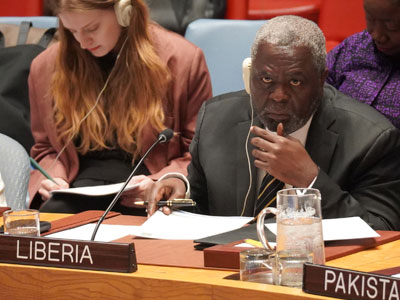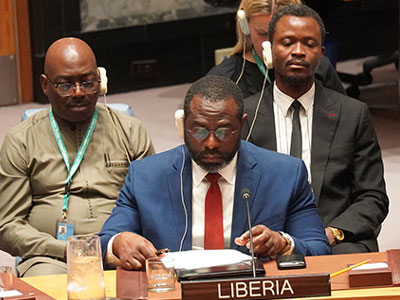
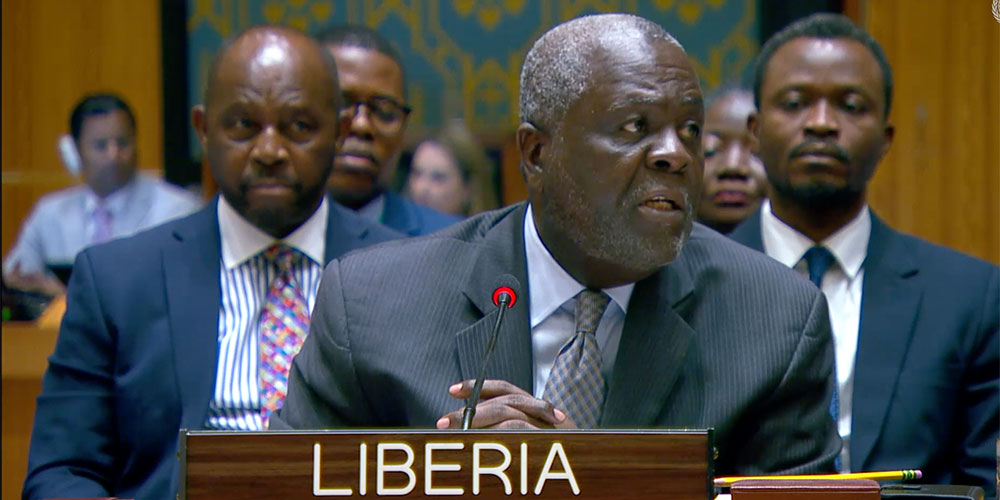
A statement on "The safety and protection of waterways in the maritime domain", as delivered by H.E. Amb. Lewis G. Brown, II, at the 10145th meeting of the UN Security Council held on Monday, April 27, 2026
Mr. President,
A few days ago, on the 22nd of April, a Liberian flagship was seized by Iran, causing damage to the vessel. And so today we speak with the clarity of an affected nation.
At the onset, we join in thanking the Kingdom of Bahrain for convening this debate at a moment when the map of global insecurity is being increasingly drawn at sea. What happens in narrow straits is now felt in distant markets, in fragile economies and at distant kitchen tables from the South to the North and from the East to the West.
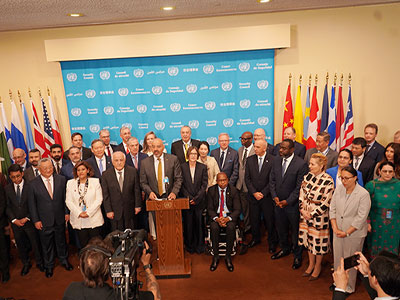
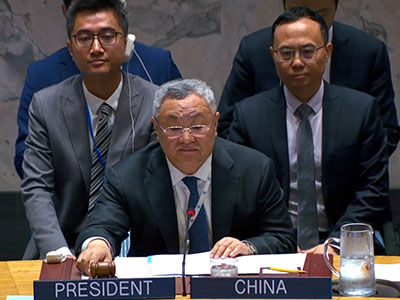
I welcome the honored presence of His Excellency, Mr. Abdul Latif bin Rashid Al Zayani, Minister for Foreign Affairs of the Kingdom of Bahrain and President of the Council; His Excellency, the Minister for Europe and Foreign Affairs of France; His Excellency, the Vice Minister for Foreign Affairs of Panama; His Excellency, the State Secretary of the Ministry for Foreign Affairs of Latvia; and His Excellency, the Minister of State of the United Kingdom.
I also thank our distinguished briefers, the Secretary-General of the United Nations, the Secretary-General of the International Maritime Organization, and a Senior Fellow of the International Institute for Strategic Studies. I thank all of you for your invaluable insights.
Mr. President, the world does not experience maritime insecurity as a naval skirmish or a distant headline—it experiences it as empty shelves, higher fuel prices, delayed humanitarian aid, and uncertainty in daily life. As we have heard, when shipping lanes are disrupted, global stability does not bend slowly; it fractures immediately.
The rise in threats to international waterways reflects a dangerous erosion of long‑established norms. Navigational rights and freedoms are being openly challenged, attacks on merchant vessels are increasing, and seafarers face growing risks along critical maritime routes.
Even where States invoke the inherent right of self‑defence under Article 51 of the Charter, the duties and obligations governing maritime security remain unassailable: civilian shipping is not a lawful target, freedom of navigation cannot be suspended by convenience, and international law does not yield to expediency. Let me be direct: today’s maritime chokepoints are no longer just passages—they are pressure valves on the global economy. When they are squeezed, the world feels it. The innocents; men, women, children, babies suffer.
In the here and now, the growing interference with commercial shipping is not incidental—it is strategic. We are witnessing the creeping normalization of disruption as leverage. That is dangerous. Because once obstruction becomes a tactic, stability becomes negotiable. And when stability is negotiable, the smallest economies, like that of my country, pay the highest price.
Given the current threats, international law must remain our anchor. The United Nations Convention on the Law of the Sea is not a suggestion—it is the operating system of the oceans. Freedom of navigation, transit passage, and innocent passage are not privileges; they are rights—rights to which the entire world is entitled. And rights cannot be selectively respected without being collectively weakened. The same applies to the law of armed conflict at sea. Civilian vessels are not, must not, and cannot be targets. Seafarers are not collateral. These are not gray areas.
Excellencies, we must confront the humanitarian dimension with greater honesty. Disruptions at sea do not stay at sea. They travel—faster than any ship—into food insecurity, into energy shocks, into delayed humanitarian relief. A blocked waterway, as we have heard, can mean an empty market thousands of miles away. That is the human cost of maritime insecurity.
As such,
Liberia offers three practical points.
First, restraint must be restored. Attacks on commercial shipping and interference with lawful navigation must end. There is no strategic gain that justifies systemic disruption of global lifelines.
Second, this Council must be consistent. Resolutions such as 2722 (2024) and 2817 (2026) are clear. But clarity is not enough—credibility on even-handed implementation, truly, must be required, because selectivity erodes this Council’s credibility and authority.
Third—we should begin to treat major maritime chokepoints as shared responsibility zones, where transparency is not optional. We propose that the Council encourage the establishment of a standing, independent incident-tracking and verification mechanism, drawing on the expertise of the International Maritime Organization, to provide real-time, depoliticized reporting on disruptions to commercial shipping. In an environment clouded by competing narratives, verified facts are a form of de-escalation.
Mr. President,
The oceans are to connect us, rather than divide us. Adherence to the laws governing the oceans guarantee our global unity and reinforce our interdependence. The oceans have always connected supply to demand and risk to responsibility. If we allow them to become theaters of unchecked disruptions, we will inherit the consequences. All of us. A divided world rather than an interdependent one.
Liberia will continue to stand for a simple principle: that the world’s waterways must remain open, governed by law, and protected not just because trade depends on it—but because trust does.
I thank you.