Implementation of the Peace, Security and Cooperation Framework for the Democratic Republic of the Congo and the Region
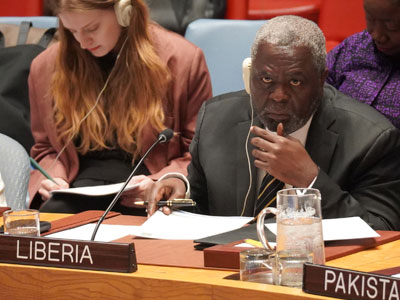
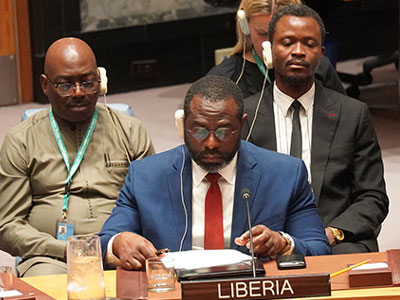
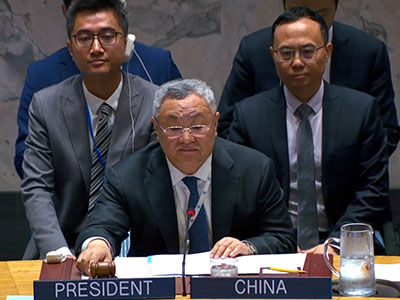
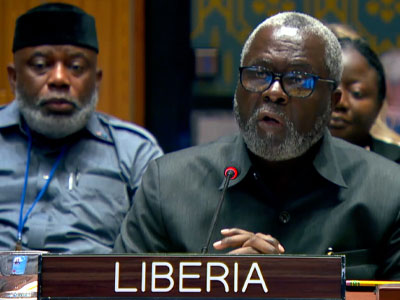
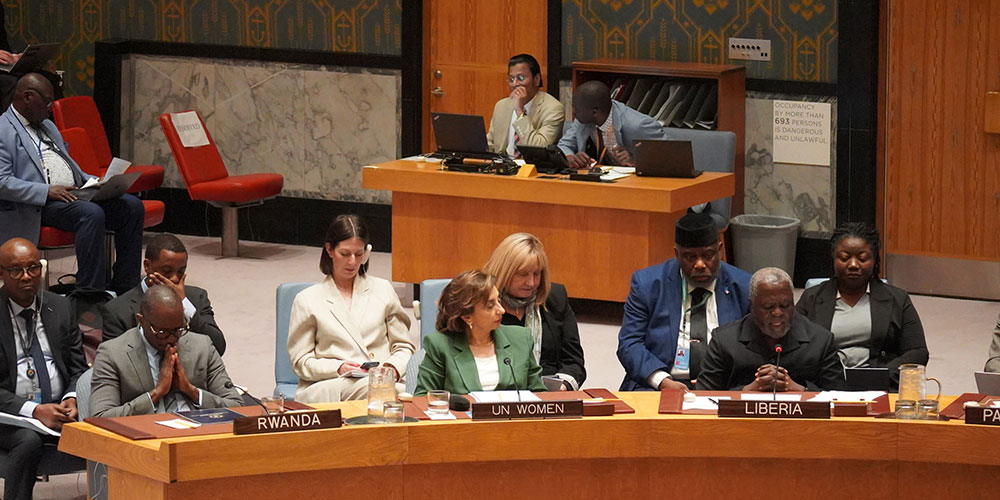
Delivered by H.E. Amb. Lewis G. Brown, II, at the 10136th Meeting of the UN Security Council, held on Wednesday, April 15, 2026
[As prepared for delivery]
Thank you, Mr. President,
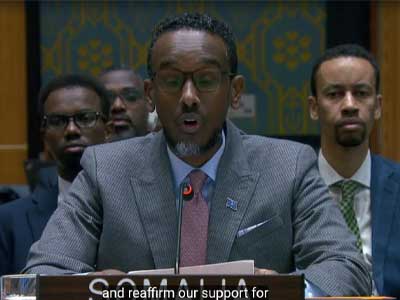
1. I have the honor to deliver this statement on behalf of the A3—namely the Democratic Republic of the Congo, Somalia, and my own country, Liberia.
2. We thank the Special Envoy of the Secretary General for the Great Lakes Region for his insightful briefing and sustained engagement. We also thank the Executive Director of UN Women for grounding our discussion in the lived realities of those most affected by this conflict. We take note of the Secretary General’s report on the implementation of the Peace, Security and Cooperation Framework, submitted pursuant to resolution 2808 (2025), and we warmly welcome the presence of colleagues and distinguished representatives from the region.
Mr. President,
3. As African members of this Council, the A3 is clear eyed about one fundamental truth: there can be no peace in Africa while the Great Lakes region remains unstable.
4. African leaders have stepped forward. African mediation is underway. These efforts deserve strong and sustained international support—matched by concrete follow through.
5. In this regard, we commend the mediation and coordination efforts led by President João Lourenço, President Faure Gnassingbé, and President Yoweri Museveni. These African led initiatives matter. But they will only succeed if they are coherent, enforced, and sufficiently supported to deliver results. When mediation speaks in multiple voices, spoilers listen carefully—and act accordingly.
6. The Washington Accords and the Doha Framework demonstrate that diplomacy remains alive. But agreements, without credible and collective commitment to implementation, do not build trust. Nor do they stop a single bullet. On the ground, trust continues to erode. Parallel power structures persist. Accusations travel faster than confidence can be rebuilt.
7. For this reason, the A3 calls for a single, results driven implementation framework—African led, and firmly anchored in the Peace, Security and Cooperation Framework. This framework must do four things, clearly and without ambiguity:
1. First, set measurable obligations with clear timelines.
2. Second, establish impartial verification, protected from political convenience.
3. Third, apply consequences when commitments are ignored.
4. And fourth, force coordination among mediation tracks, rather than competition between them.
Mr. President,
8. Peace may be declared in agreements. But experience teaches us that, too often, peace must be enforced through discipline and accountability.
9. The security situation in eastern Democratic Republic of the Congo is deteriorating—not incrementally, but dangerously. It poses a serious threat to regional and international peace. The A3 calls for an immediate end to hostilities, as required by resolution 2773 (2025) and reiterated in resolution 2808 (2026). The same obligation is embedded in the Washington Agreements and the Doha Process. These commitments must be fully respected.
10. We are deeply concerned by the continued expansion of armed groups, including the use of heavy weapons and armed drones in civilian areas, in clear violation of international humanitarian law. These actions cannot be ignored. The A3 condemns them without qualification.
11. Let us be clear: international humanitarian law is not optional.
Respect for sovereignty and territorial integrity is non negotiable.
Failure to reverse this trajectory risks regional spillover and dangerous miscalculation.
12. In this context, the A3 welcomes all initiatives aimed at accelerating the operationalization of the Disarmament, Demobilization and Reintegration Programme for foreign combatants. We reiterate our call for sustained support to this programme. Each country in the region must assume its responsibilities by establishing national mechanisms to address armed groups operating within its territory and facilitating their return to their countries of origin.
Mr. President,
13. The humanitarian situation remains dire. More than six million people have been displaced. Children are malnourished—not because solutions are lacking, but because resources have not arrived. Humanitarian response plans remain severely underfunded. Access is constrained. Host communities are stretched to the breaking point.
14. Humanitarian response cannot rely on sympathy alone. It requires predictable financing, unconditional access, and fair burden sharing.
15. In this regard, the A3 calls upon UNHCR to work closely with countries of the Great Lakes Region to strengthen a regional approach to cross border refugee risk management, and to ensure that, when conditions permit, refugees are supported in achieving a safe, voluntary, and dignified return to their respective countries.
Mr. President,
16. Protection of civilians is not a footnote to mediation. It is the measure of whether mediation is worth the name. Accountability must advance alongside dialogue—not later, not someday, but now. Peace built on silence around abuses will not endure.
Distinguished colleagues,
17. The conflict in the Great Lakes region is sustained not only by weapons, but by profits. The illicit exploitation of natural resources continues to finance instability. Tackling impunity in this domain requires action across the entire chain—from production to exploitation.
18. The A3 therefore welcomes efforts, including those emerging from the Gaborone workshop, to strengthen transparency, traceability, and governance in the extractive sector. We also support the establishment of a mechanism, similar to the Kimberley Process, to address gold from conflict zones. Disrupting the political economy of violence is not secondary—it is central to ending this war.
Mr. President,
19. The Peace, Security and Cooperation Framework remains the region’s most credible roadmap. But roadmaps do not move people—decisions do.
20. The people of the Great Lakes do not need more agreements. They need proof that agreements matter. This Council must signal—clearly and collectively—that obstruction will be exposed, violations will be addressed, and African led solutions will be matched by international resolve.
21. Anything less risks turning this moment into yet another missed opportunity—a failure none of us should accept.
22. In closing, the A3 reaffirms its unwavering support for the sovereignty and territorial integrity of the Democratic Republic of the Congo and of all the brotherly nations of the Great Lakes region—an essential pillar of our African continent.
I thank you.