UN Organization Stabilization Mission in the Democratic Republic of the Congo (MONUSCO)
Mr. President,
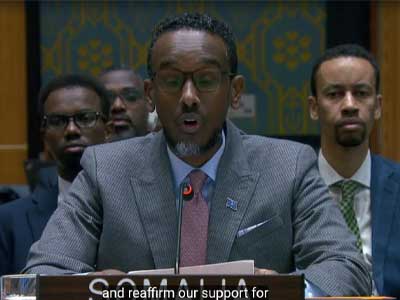
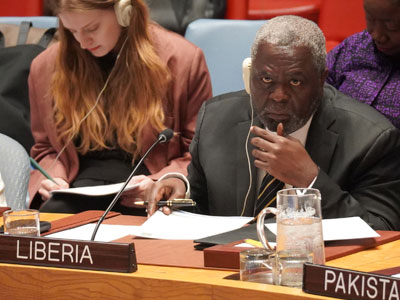
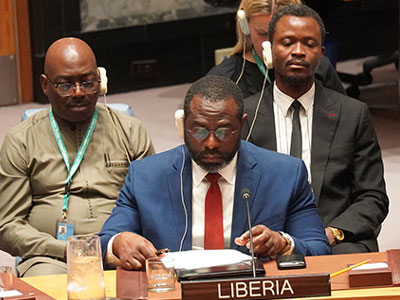
1. I have the honour to deliver this statement on behalf of the A3—namely, the Democratic Republic of the Congo, Somalia, and Liberia.
2. We thank the Special Representative ad interim, Ms. Vivian van de Perre, for her briefing. We also recognize the service of outgoing SRSG Ms. Bintou Keita and welcome Mr. James Swan as he assumes leadership of MONUSCO at this pivotal moment.
Mr. President,
3. For too long, eastern Democratic Republic of the Congo has been the arena where old grievances, new ambitions, and external interests converge—with devastating consequences for civilians. The recent use of sophisticated aerial assets, including drone attacks in Kisangani and Goma, marks a dangerous escalation. Civilians, humanitarian actors, and UN personnel have again paid with their lives. These are violations, but more importantly, they are affronts to our shared humanity. In such circumstances, the implementation of a ceasefire is not only urgent—it is indispensable.
4. On diplomatic efforts, the A3 urges all parties to take immediate steps to halt the violence and to bridge the persistent gap between diplomatic progress and security realities on the ground. We commend the State of Qatar, the United States, the African Union, and Angola for their respective roles, and we welcome the Washington Agreements of December 4, 2025, concluded under United States auspices.
Mr. President,
5. The Secretary‑General, in his letter of February 27, 2026, noted that MONUSCO may require an additional deployment, within the phased approach, to provide sustainable support for monitoring and verifying the ceasefire in North and South Kivu. The A3 remains committed to this objective.
6. However, adherence to the ceasefire continues to face serious obstacles. On December 10, 2025—one day after the Washington Agreements—the AFC/M23 and its supporters seized Uvira, a city of strategic importance to both the DRC and Burundi. Only sustained international pressure led to their announced withdrawal on January 17, accompanied by their call for the deployment of a neutral international force to enable a credible resumption of political efforts.
7. In this context, the A3 welcomes the signing of the Terms of Reference for the Expanded Joint Verification Mechanism (EJVM+) during the seventh COVM meeting in Doha on February 2, 2026. The deployment of EJVM+ missions to Uvira represents an important step toward operationalizing the ceasefire architecture and demonstrates a willingness by the parties to de‑escalate.
8. The A3 further encourages all political and diplomatic efforts to implement the ceasefire mandated in Resolution 2773 (2025) and reaffirmed in Resolution 2808 (2026). The Washington Agreements and the Doha Process impose clear obligations to de‑escalate and cease hostilities. These obligations must be fully respected.
Mr. President,
9. Despite progress in some areas, the full operationalization of ceasefire mechanisms remains incomplete. The Council must treat the realization of a ceasefire as an absolute priority. The A3 calls on the African Union, the United States, and Qatar—as designated mediators—to intensify their efforts and maintain consistent pressure on all parties. There is momentum that must not be lost, lest eastern DRC once again descend into large‑scale war with the risk of a broader regional crisis.
Mr. President,
10. The African Union has long affirmed that African challenges require African leadership, supported by genuine international partnership. This moment demands that resolve. To avoid yet another cycle of stalled progress, the A3 stresses the need for a consolidated Peace Implementation Architecture—one that brings together regional initiatives, ensures coherence in implementation, and guarantees transparent reporting to this Council.
Mr. President,
11. Allow me to highlight several points aimed not at commentary, but at course correction.
12. First, the region has no shortage of agreements. What is missing is implementation. The Washington Accords for Peace and Prosperity of December 2025 reaffirm commitments to troop withdrawal, economic cooperation, and previous agreements. Subsequent steps taken in Washington in March 2026 outline coordinated measures to safeguard sovereignty, disengage forces, neutralize armed groups, and protect civilians. But agreements do not implement themselves.
13. The A3 therefore calls for a regional Peace Implementation Architecture with clear benchmarks, third‑party verification, time‑bound obligations, and agreed consequences for non‑compliance. Building agreements without implementation mechanisms only builds hope without outcomes. Peace must be engineered, not imagined.
14. Second, the protection of civilians must be a priority. The humanitarian crisis—6.5 million internally displaced and 27 million facing acute food insecurity—demands urgent action. Airports in Goma and Kavumu must reopen immediately to allow humanitarian flights and MONUSCO operations. Attacks on civilians, humanitarian personnel, and UN staff are unacceptable and require independent, impartial investigations.
15. Third, MONUSCO must be strengthened as a pillar of peace. Contingency measures have already reduced its uniformed presence by 23.4 percent. Any further drawdown must be responsible, conditions‑based, and aligned with the protection of civilians. It is unreasonable to expect MONUSCO to deliver on its mandate with diminished capacity. The A3 calls for adequate, predictable, and sustainable funding for MONUSCO; full freedom of movement; operational guarantees for ceasefire monitoring; and coordinated cooperation with regional mechanisms.
16. Fourth, accountability must be restored. Multiple investigations have confirmed external involvement, support to armed groups, and illegal resource exploitation. Impunity fuels this conflict; accountability must extinguish it.
17. Finally, diplomatic efforts cannot operate in silos. The A3 calls for harmonized reporting among mediation tracks, a unified monitoring mechanism, and regular joint briefings to the Security Council. When mediators coordinate, parties cannot evade responsibility.
Mr. President,
18. The A3 reaffirms its unwavering commitment to the sovereignty, independence, unity, and territorial integrity of the Democratic Republic of the Congo. We commend the resilience of the Congolese people, who deserve more than sympathy—they deserve results. If this conflict persists, it will not be for lack of solutions but for lack of will to implement them.
19. The DRC is not short of commitments. What is needed now is coherence, discipline, and accountability. Peace will not be secured by the accumulation of agreements, but by their faithful execution. We must ensure this moment does not become another missed opportunity.
I thank you.