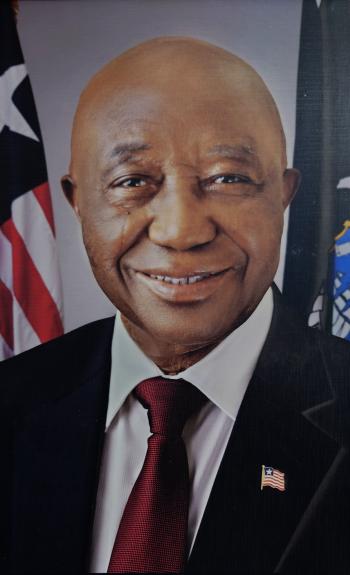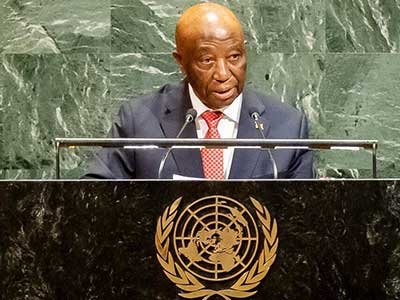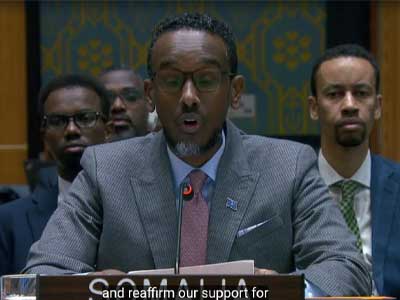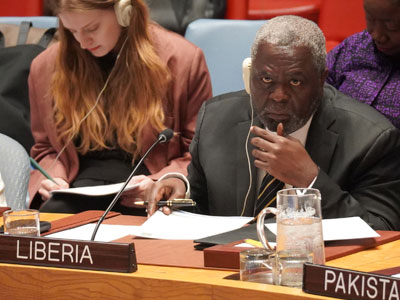
Delivered by Amb. Lewis Garseedeh Brown II, Permanent Representative of the Republic of Liberia to the United Nations, at the 10,102nd Meeting of the Security Council; UN HQ, New York | Thursday, February 5, 2026:
Thank you, Mr. President,
1. I have the honor to deliver this statement on behalf of the A3, namely the Democratic Republic of the Congo, Somalia, and my own country, Liberia.
2. The A3 extends sincere thanks to the distinguished briefers for their qualified insights:
• Mr. Jean-Pierre Lacroix, Under Secretary General for Peace Operations
• Mr. Meinolf Schlotmann, Police Commissioner, UNMISS
• Ms. Mamouna Ouedraogo, Police Commissioner, MONUSCO, and
• Mr. Faisal Shahkar, United Nations Police Adviser
3. Today, before discussing mandates, models, or reforms, we honor all the blue beret and helmets who continue to serve selflessly with dedication and professionalism often in increasingly challenging environments.
4. We also salute the significant contribution of African Peacekeeping and police-contributing countries, which account for a substantial portion of UNPOL deployments and whose continued commitment strengthens UN operations globally.
5. Since 1948, UN peace operations have recorded more than 4,300 fatalities, including police, military, and civilian personnel.
6. These numbers are not abstractions. They represent officers who patrolled alleys they did not grow up in, defended communities they had never met, and paid the ultimate price for a peace they would never get to see. May their ultimate sacrifice for peace realize the results they paid dear for.
Mr. President,
7. Africa’s experience with UN Police is both extensive and instructive, carrying a unique burden—and credibility. We are home to the largest number of UN missions, and we contribute some of the largest contingents of police personnel.
8. This dual role gives us a clear message: UN policing works best when it strengthens national institutions—not when it substitutes for them.
9. The A3 position is simple:
• Support must be requested, not presumed.
• Assistance must be partnership, not parallelism.
• Capacity must be transferred, not temporarily rented.
10. Experience across the continent shows that sovereignty and effectiveness are not competing goals. For the purpose of sustainable peace, sovereignty and effectiveness must be mutually reinforcing.
11. In Liberia, UNMIL did not deliver miracles, but it delivered something far more valuable: patient, nationally led police reform anchored in community trust. The result was a police service Liberians recognize as their own. The lesson is clear: peace that is imposed fades; peace that is owned endures.
12. The A3 priority for the future of UN Policing is to make capacity real, not rhetorical. Training that stops in the classroom is good, but not enough training. Real capacity comes from joint patrols, joint investigations, leadership mentoring, and systems reform rooted in national strategy. This is how police institutions become resilient, not reliant.
Mr. President,
13. The Security Council must match mandates with means. Too often, the Council authorizes what it does not adequately resource--creating gaps between ambition and deployment as well as intentions and outcomes, gaps which deepen insecurity for those in need. A mandate without means is an unkept promise - an unjustified risk that is too high for citizens and peacekeepers.
14. At the same time, Mr. President, this Council must continue to avoid the temptation to make peacekeeping mandates about the interests of individual members of the Council over those for whom the resolutions are intended to assist. Mandates must be clear, not confusing.
15. We must modernize responsibly, void of technological dependency. Technology shapes everything from human trafficking to digitally coordinated violence. UNPOL must have these tools—but host States must own, operate, and sustain them long after missions depart. We cannot replace outdated forms of dependency with digital dependency.
16. Women in policing should be an intrinsic part of the strategy, not symbolism. Women police officers open doors that weapons cannot. Their presence improves intelligence, strengthens community trust, and reduces fear and stigma in conflict settings. We therefore call for greater deployment, leadership, and retention of women police officers—because this is operational necessity, not symbolic inclusion.
Mr. President,
17. To achieve these objectives, the partnership between the AU and the UN must be strengthened. African institutions—from the AU Peace and Security Architecture to Silencing the Guns—are not slogans. They are living frameworks built on continental experience and legitimacy. UNPOL must operate with these frameworks, not around them.
18. The A3’s vision rests on three pillars: Partnership, Empowerment, Sovereignty.
19. As we look ahead, our message is firm:
• From intervention to partnership.
• From substitution to empowerment.
• From international ownership to national sovereignty.
• From parallel structures to strong, permanent, nationally led police services.
20. When a UN police mission closes, its success should not be measured by the number of vehicles it leaves behind, but by the strength and legitimacy of the national police service that remains standing.
21. Africa is not merely asking for better missions—we are shaping the next generation of peace operations.
To conclude, Mr. President,
22. We, the A3, commit to working with all partners to ensure that UN policing becomes what it must be:
• a catalyst for national capability,
• a defender of sovereignty, and
• a builder of lasting peace that the people of Africa deserve.
I thank you.