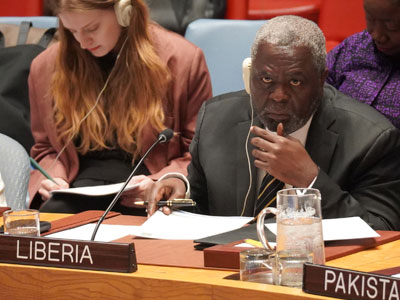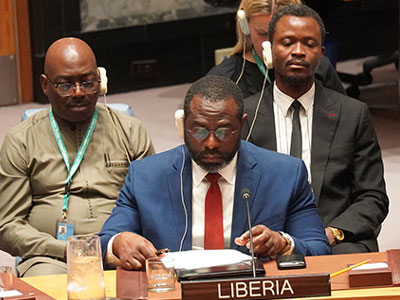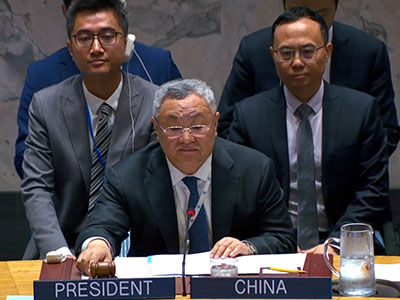
Security Council Chamber, UN HQ, Manhattan, New York, United States | January 28, 2026: Thank you, Mr. President. I thank the Somali Presidency for convening this high-level debate and the briefers for their insightful interventions. Mr. President, Excellencies, the Middle East is not a distant theatre of conflict. It is a central test of whether this Council can still shape outcomes rather than merely catalogue suffering.
In the Middle East, we do not confront one crisis. We face a chain reaction of wars, reprisals, and unresolved grievances—each feeding the next. Liberia’s own experience reminds us that silencing guns matters, but peace does not come from silence of the guns alone. It comes from choices—made early, deliberately, and sustained over time.
Mr. President,
For millions in the Middle East, war is not an interruption of life. It is life itself. There are people who were born under bombardment, who learned adulthood under occupation or siege, and who will grow old without ever knowing what it means to live without fear. Entire lives—full lives—have been lived inside conflict, from first breath to last.
And nowhere is this tragedy more unforgivable than in the lives of children.
Some babies die while trying to nurse from mothers whose bodies have nothing left to give. They die not from rare disease or unavoidable fate, but from hunger, blockade, displacement, and decisions made far from their cries. This is not abstract. This is happening in real time.
Children are growing up inside the wreckage of our choices. They inherit wars they did not declare, hatreds they did not choose, and borders drawn more fiercely than compassion. They carry the cost of adult power struggles because the international community has too often accepted delay, denial, and turning a blind eye as its policy.
While children elsewhere worry about exams, football matches, music, friendships, and what they might become in the future, children in conflict zones in the Middle East learn how to stay safe during explosions and the best route to take to find food. They live in fear not knowing what it means to be free. This is not only a moral failure. It is a strategic catastrophe that recycles violence, enmity, and hate.
Mr. President, Excellencies:
The reality of the Middle East is unfortunately grim, but the horizon beckons hope. Liberia notes recent diplomatic efforts aimed at reducing violence and reopening political space in Gaza and across the region. We applaud initiatives led by Qatar, Egypt, the United States, regional leaders, and other stakeholders which has helped to create momentum toward deescalation, improved humanitarian access and dialogue. Progress, however fragile, matters.
But let’s be clear. Momentum must be sustained. Therefore, Liberia encourages continued engagement with this Council and with all stakeholders to deepen the progress, seize every opportunity, and consolidate the gains already made. History shows that diplomatic openings, will close inevitably, not because they are imperfect, but because they are abandoned.
Mr. President,
No conflict has more broadly defined the region than the one between Israel and Palestine. Liberia is concerned by this protracted conflict. We reiterate the urgent need for immediate and sustained de-escalation and for expanding humanitarian access that is predictable and safe.
Liberia continues to support a negotiated two-State solution, consistent with relevant Security Council Resolutions. Security that lacks political legitimacy cannot endure. Crisis management, however necessary, cannot substitute for a genuine peace process.
Mr. President, Excellencies:
Force can dominate a moment; but only justice can shape a future. If force worked, we would not be here having this debate. What is not resolved through dialogue will resurface louder, angrier, and more dangerous, hence any solution must be shaped with the involvement of all concerned stakeholder.
Mr. President, Excellencies,
Beyond Gaza, we are alarmed by rising tensions along the Blue Line between Israel and Lebanon. We recall Security Council Resolution 1701 and support UNIFIL’s stabilizing role.
In Syria, humanitarian suffering continues amid political paralysis. Resolution 2254 remains the agreed framework for sustainable peace. Regional engagement must translate into political movement that is genuinely inclusive, not an acceptance of permanent stagnation.
In Yemen, fragile steps toward de-escalation offer a chance that must not be squandered. Dialogue remains the only path that does not end in more deaths and destruction.
Mr. President,
Peace in the Middle East cannot be defined simply by what ends; it must be defined by what begins – dignity, justice, and the freedom for people to build ordinary lives. It must offer a future where Jews and Palestinians, Christians and Muslims, Arabs and non-Arabs can live not only side by side, but together - working in the same hospitals, trading in the same markets, studying in the same universities, protecting shared water sources, building businesses, and competing in ideas rather than with arms.
Finally, Mr. President,
Liberia will close with the following:
- We call for expanded, regular humanitarian corridors into Gaza and all conflict zones in the region.
- We urge support for confidence-building measures facilitated by UN peacekeeping and regional partners.
- We encourage regional actors and international partners to sustain diplomatic momentum and avoid the collapse of current openings.
- We call on all stakeholders to support efforts that restore political legitimacy, governance capacity and economic stability for both Israelis and Palestinians; and,
- We stress the need to promote regional commitments to stop the use of children in conflicts, and to shield schools and hospitals from attacks and misuse.
Liberia stands ready to work with all Council members, the United States, regional partners, and all stakeholders to work for sustainable peach in the Middle East.
Thank you, Mr. President.