
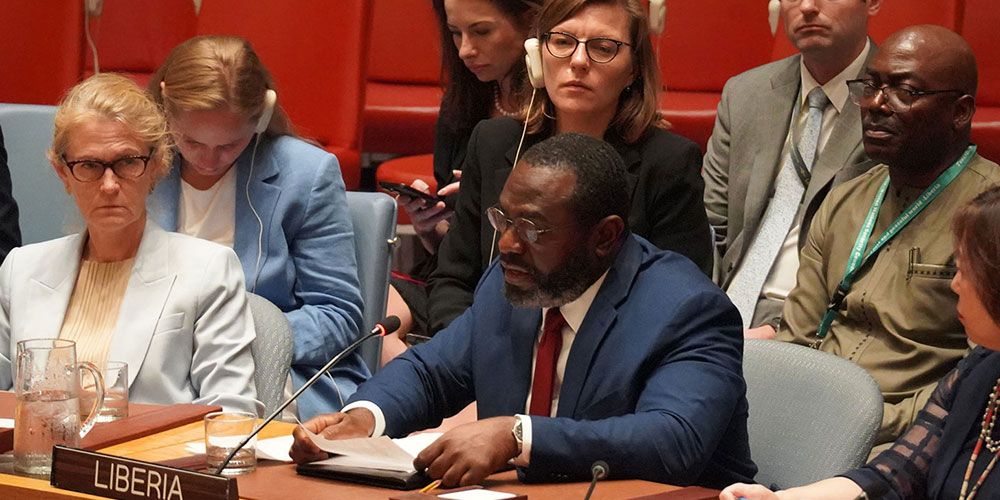
A statement on "Maintenance of Peace and Security of Ukraine", as delivered by Deputy Permanent Representative H.E. Baba Sillah, at the 10152nd meeting of the UN Security Council held on Tuesday, May 19, 2026
Thank you, Mr. President.
Liberia thanks Denmark, France, Greece, Latvia and the United Kingdom for convening this meeting.
Liberia also thanks Ms. Kayako Goto, Director and Officer in Charge for Europe, Central Asia and the Americas for the Department of Political and Peacekeeping Affairs and Peace Operations, as well as the Office for the Coordination of Humanitarian Affairs Crisis Response Division, Director Ms. Ideom Osohno for their informative briefings.
We also welcome delegations joining us today for this briefing. Liberia speaks today not to rehearse the facts before us, but to confront what they signify. We are witnessing not simply the persistence of conflict in Ukraine, but a hardening pardon. Attacks and deadly violence are becoming more frequent, more expensive, and the deadly violence are becoming more embedded in the civilian environment. Recent UN monitoring indicates that April alone saw at least 238 civilians killed and more than 1,400 injured, the highest monthly toll in nearly a year, underscoring a worsening trajectory.
The distinction between military objectives and civilians is being dangerously eroded in apparent violation of international humanitarian law. The Council meets following a further reported surge in attacks, including extensive drone and missile strikes across multiple regions, as documented by UN entities and humanitarian partners. With rising civilian casualties and significant damage to energy and industrial infrastructure, what is most concerning is not only the skill, but the timing. Escalation appears to be advancing, even in moments when restraint could have opened a diplomatic pathway. Against this backdrop, Liberia wishes to make the following points.
First, the human dimension must not be forgotten. Behind every casualty is a person, a life, a mourning family, a future lost. This requires sharper focus and stronger effort from this Council. Reports of attacks and harm to civilians and civilian infrastructure, the situation of children separated from families, and the treatment of prisoners of war point to gravely concerning issues that cannot be deferred to a later political settlement. They demand immediate action, credible accountability mechanisms and sustained monitoring. They demand action now, not deferred commitments. Liberia strongly condemns all attacks on aid workers and stands in solidarity with humanitarian personnel who risk their lives every day to bring relief to people in need.
Second, we must reassert a simple principle. Wars are judged not only by how they fought, but by what they leave behind.
The cumulative impact of strikes on power grids, rail systems and on civilians and their lifelines and critical infrastructure is not incidental. It reshapes entire societies and generations ahead. In Africa, including in Liberia's own experience, the collapse of such systems turned conflict into protracted national crises with consequences we are still battling today. The Council must therefore insist clearly and consistently that international humanitarian law is not optional and when violated, there must be consequences, including through appropriate international investigative and accountability mechanisms. The obligations are clear. Parties must distinguish, must ensure proportionality and must take all feasible precautions to protect civilians and the critical infrastructure systems that sustain them. Liberia urges renewed urgency in upholding the protection of civilians, ensuring the safety and reunification of children and guaranteeing the humane treatment of all detainees without exception and in all circumstances.
Third, this conflict is entering a phase where escalation risks become self-sustaining. The emerging pattern of strikes and counter strikes is creating a self reinforcing escalation loop that sidelines diplomacy. History shows that when wars reach this stage, they do not end decisively. They end painfully and often unpredictably. For the Council, the implication is clear. Managing escalation is no longer enough. We must begin to disrupt it.
In conclusion, Mr. President, Liberia calls for an immediate halt to attacks on civilians and civilian infrastructure consistent with international humanitarian law. As the Secretary-General has warned, this war remains a stain on our collective conscience with a human toll that continues to deepen. Therefore, even limited reciprocal steps toward de-escalation can begin to alter the trajectory of this conflict.
Liberia underscores that diplomacy must remain primacy. Any sustainable outcome will require engagement anchored in the Charter, including respect for sovereignty and territorial integrity. There is no alternative pathway that avoids prolonged instability.
And I thank you.