
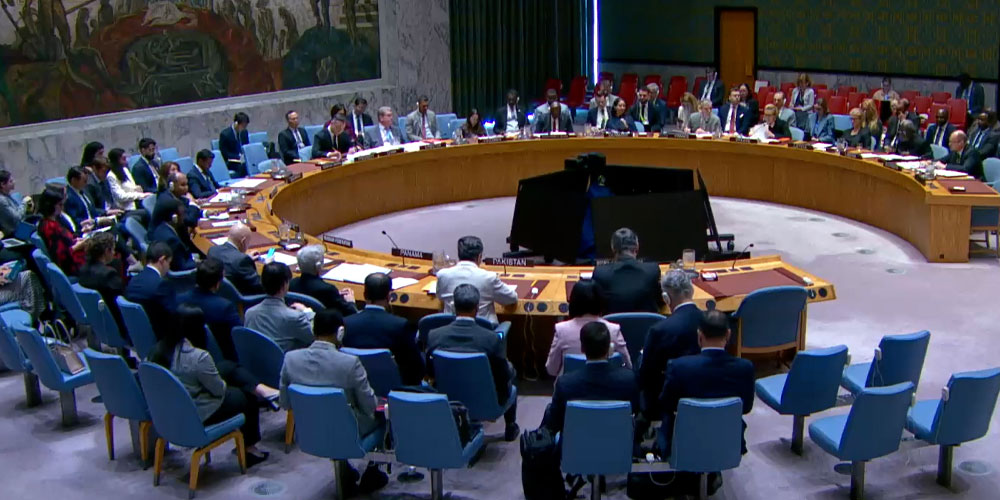
Liberia's statement on "The Situation in Bosnia and Herzegovina", as delivered by H.E. Amb. Lewis G. Brown, II, at the 10150th meeting of the UN Security Council held on Tuesday, May 12, 2026
Thank you. Thank you, Mr. President. And I join in congratulating you for assuming the presidency of the Council. And please be assured of Liberia's continued Support. Liberia thanks Mr. Christian Smith for his important briefing and the quality of his service to the Chair of the Presidency of Bosnia and Herzegovina. Please accept our welcome. Mr. President, Excellencies. Liberia approaches this debate not as a distant observer, but as a country acquainted with the long labor of rebuilding a fractured state. We know that wars do not end when guns fall silent. They end when institutions become stronger than grievances, when citizenship becomes more powerful than ethnicity, and wars end when political leaders learn that restraint is also a form of patriotism.
Bosnia and Herzegovina stands at a consequential moment. Nearly three decades after Dayton, the country continues to navigate unresolved constitutional questions, competing political visions and recurring tensions over the distribution of authority. Recent developments remind us that peace agreements are not self-sustaining documents. They survive only when political actors choose preservation over provocation.
Liberia therefore wishes to underscore the following points:
First
Democratic processes must remain instruments of legitimacy, not rehearsals for divisions. The recent snap presidential election in Republika Srpska, together with the subsequent annulment of results in several polling stations due to reported irregularities, reflects both the resilience and fragility of democratic institutions.
Elections must never become contests over who can most effectively inflame public fear. The true strength of democracy is measured not by victory margins but by the confidence of those who lose. As Bosnia and Herzegovina approaches elections in October, Liberia urges all political leaders to reject inflammatory rhetoric and recommit themselves to constitutional dialogue and peaceful political competition. History teaches a very simple but unforgiving lesson. Words spoken recklessly in divided societies rarely will remain only words.
Second
Civic space and human rights protections must be preserved with vigilance. Societies emerging from conflict cannot afford the erosion of independent media, civil society, or institutions of accountability. When scrutiny is treated as hostility, democratic decline often follows quietly before it arrives dramatically. A state does not become weaker because citizens ask questions. It becomes weaker when citizens become afraid to ask them.
Liberia therefore calls for the protection of human rights defenders, minority communities, and independent institutions alongside stronger efforts to confront hate speech and incitement before they calcify into political culture.
Third
Liberia recognizes the continuing relevance of the Office of the High Representative under the datum framework. We acknowledge that perspectives differ within this Council. Yet the central question should not be whether international mechanisms are ideal, but whether conditions presently exist for their safe and responsible withdrawal. Peace implementation mechanisms are truly not invitations to dependency. What they are really are guardrails against aggression or rather regression. So long as core provision of the peace agreement remain contested, stabilizing structures retain practical importance.
Liberia once again encourages constructive engagement with the High Representative and continued progress toward fulfillment of the 5+2 Agenda.
Fourth
The sovereignty, territorial integrity, and multi ethnic character of Bosnia and Herzegovina are not matters for selective interpretation. The Dayton Peace Agreement ended one of the darkest chapters in modern European history because it established a framework within which coexistence became possible, again. No society remains stable when constitutional order becomes conditional upon political convenience.
Liberia urges all actors, domestic and external, to refrain from conduct that could embolden separatist tendencies or deepen ethnic polarization.
Political ambition must never be allowed to outrun the requirements of peace.
Fifth
The socioeconomic dimension deserves far greater attention in conversations about stability and security in Bosnia Herzegovina. Persistent political analysis carries human consequences:
- Young people leave. We've seen that in my country.
- Public trust erodes.
- Communities become vulnerable to cynicism and extremism.
- A generation without economic hope becomes fertile ground for political instability.
Liberia therefore encourages sustained support for reforms that strengthen institutions, widen opportunity, reduce discrimination and restore public confidence in governance.
Mr. President,
Liberia's own history has taught us that reconciliation is not the absence of disagreement. It is the collective decision that disagreement will no longer be settled through national ruptures.
Peace survives where institutions are trusted, where rights are protected without qualification, and where leaders understand that national unity is not inherited automatically by states emerging from conflict. It must be renewed continuously through political wisdom and civic courage.
To conclude, Mr. President,
Bosnia and Herzegovina has come too far and sacrificed too much for the architecture of peace to be weakened by recurring cycles of confrontation.
Liberia therefore calls on all political leaders to reaffirm through both word and conduct their commitment to constitutional order, non violence, inter ethnic trust and the peaceful resolution of disputes.
For in the end, the durability of peace depends less on the text of the agreements than on the character of those entrusted to uphold them.
I thank you for your kind attention.