
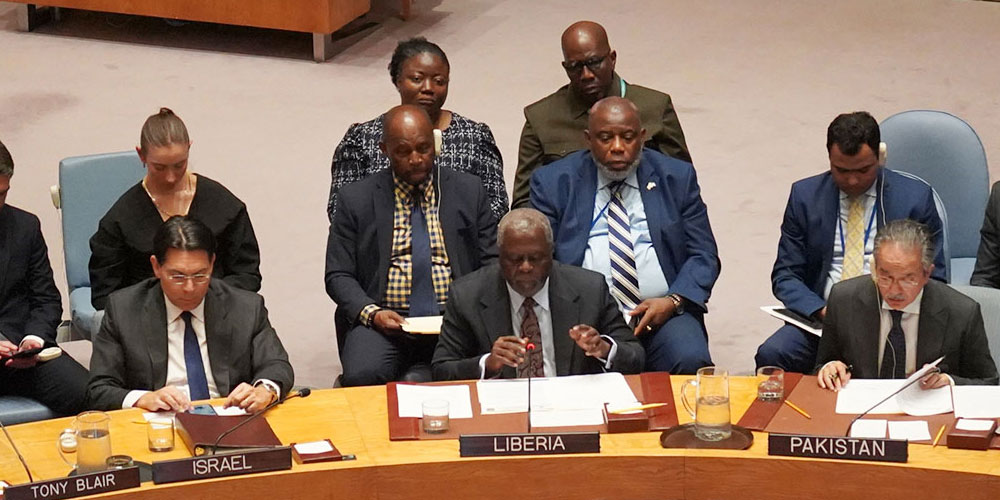
Liberia's statement on "The Situation in the Middle East including the Palestinian Question", as delivered by H.E. Amb. Lewis G. Brown, II, at the 10146th meeting of the UN Security Council held on Tuesday, April 28, 2026
Thank you, Mr. President,
We salute the gallantry of the men and women deployed across the Middle East in peacekeeping duties under increasingly difficult conditions.
We express condolences to all peacekeepers who have paid the ultimate prize in the search for peace in the Middle East and other hotspots around the world, under the blue flag. We pray for the full recovery of all those injured in the selfless pursuit of peace and wish their families well.
We express our appreciation to the briefers: Mr. Khaled Khiari, Assistant Secretary‑General for the Departments of Political and Peacebuilding Affairs and Peace Operations; His Excellency Mr. Espen Barth Eide, Minister for Foreign Affairs of Norway and Representative of the Ad Hoc Liaison Committee; and Mr. Tony Blair, Member of the Executive Board of the Board of Peace, for their insightful interventions.
Mr. President,
We also welcome the participation of the Observer State of Palestine, represented by Her Excellency Ms. Varsen Aghabekian, Minister for Foreign Affairs and Expatriates, as well as the distinguished representative of Israel and the many Excellencies and distinguished colleagues of Member States taking part in today’s important debate.
Excellencies, this Council meets while the history of the Middle East is still being written in blood. This is not dramatic. It is being realistic.
But, the truth is that a course correction is not yet beyond us. The present pause, however, in large scale violence must not be mistaken for peace. Ceasefires may interrupt warfare. The truth, however, is that they do not by themselves resolve the political disagreement that produced the war.
The lesson before us is therefore a sobering one. When diplomacy repeatedly arrives only after devastation, which has been the unfortunate tale of the Middle East conflict, peace becomes about reconstruction instead of what it should truly be—about prevention of a war.
Liberia speaks with the humility of a nation that learned through painful experience that wars prolonged by grievance do not end when battlefields quiet. They mutate into economic ruin, institutional decay, and inherited trauma.
My country knows what it means when justice is deferred in the name of strategy. We know that the pursuit of absolute security through permanent escalation often produces not strategic victory, but strategic exhaustion and overall insecurity.
A conquest that requires permanent vigilance is not peace; it is deferred instability. This truth is urgently relevant today.
Mr. President, in Gaza, as we have heard from the Secretariat, the humanitarian situation, while improving, remains desperate. Tens of thousands of lives have been lost since October 2023. Entire neighborhoods have been erased. More than 370,000 housing units have reportedly been damaged or destroyed. Gaza’s economy has contracted by over 80 percent, with development indicators pushed back by decades. These are not merely statistics of destruction. They are indicators of a political failure, one that is so profound that humanitarian relief alone cannot and will not repair it.
We thank the Board of Peace, the United States and all countries contributing to the progress which have been reported to us by Mr. Blair. What is also true is that Gaza cannot again become an internationally funded humanitarian holding pattern, rebuilt materially, abandoned politically and left strategically combustible without being properly and thoroughly disarmed.
Reconstruction without irreversible political architecture will only recycle fragility.
Liberia therefore calls for a time-bound international framework that links recovery, governance, accountability, and a credible, irreversible pathway toward the Two-State Solution. Bricks alone cannot build peace. Cement without political courage merely rebuilds future ruins.
Mr. President,
Mr. President, Excellencies, as the Assistant Secretary-General reminded us, the Palestinian Question remains central to peace in the Middle East and the crisis is no longer geographically confined. From Gaza to the West Bank, from the Blue Line to the Red Sea, from the Strait of Hormuz to Yemen and Syria, we are witnessing the dangerous fusion of unresolved grievances into interconnected regional instability.
It is worth repeating because it is true. When nearly one third of globally traded seaborne oil and a significant share of liquefied natural gas transit through vulnerable maritime corridors, disruption in the Strait of Hormuz is not a regional inconvenience. It is a systemic global threat.
For vulnerable economies, especially in Africa and certainly in my country, rising fuel prices mean higher food costs, weakened fiscal spaces, disrupted fertilizer supply chains, and millions more already at the risk of poverty, slipping deeper into poverty.
For Liberia, one of the world’s leading maritime registries, attacks on international shipping are not abstract geopolitical events; they are assaults on the legal arteries of global commerce, sovereign equality, and international order.
Mr. President, Freedom of Navigation through international waterways, as we heard a lot of from many Member States yesterday, is not optional. It is a legal obligation. The obstruction, weaponization or militarization of these routes risks transforming regional war into global economic depression.
Liberia, therefore reasserts the African Union affirmation that international law cannot be selectively applied, whether on land, at sea or in humanitarian access.
The forcible displacement of civilians, therefore, must not be normalized. Territorial acquisition by force cannot and must not be legitimized. Humanitarian aid must not and cannot be permitted to be weaponized and maritime passage cannot be obstructed.
Excellencies, the selective enforcement of law does not preserve order. It actually weakens it. This Council must confront an uncomfortable truth. Resolutions repeatedly invoked but inconsistently implemented do not strengthen our credibility or the credibility of the international community. In truth, they erode it.
Resolutions 2720, 2735, 1701, 2334 and 2803 cannot remain ceremonial texts recited in this chamber, while realities on the ground move in the opposite direction. Our collective resolve to implement our resolutions is the real difference between peace and security in the Middle East.
Liberia reaffirms its support for the inalienable political rights, dignity and statehood aspirations of the Palestinian people alongside Israel’s right to security guaranteed not by perpetual siege, but by enforceable coexistence within internationally recognized parameters, all of which are enshrined in many resolutions concerning the Middle East.
These objectives are not contradictory. As we have just heard from both distinguished representatives, durable peace through permanent insecurity of the other is neither desirable nor sustainable. Neither side can secure durable peace through the permanent insecurity of the other.
20. Mr. President, the choice before this region is no longer simply war or ceasefire. It is whether leaders will invest in peace, however imperfect, and doing so today, or pursue absolute advantage tomorrow only to inherit insecurity across borders, economies and generations.
The Middle East does not need another generation being taught to survive unresolved history. It needs leadership and it needs it desperately. One that is willing to resolve the conflict that is faced by the Middle East today, with courage and unity of purpose now, not tomorrow, so a future generation has a better chance of a peaceful life and the chance of good neighborliness.
My country’s own history, and excuse me if I’m passionate, my country’s own history, teaches us that the most dangerous conflicts are often not those that cannot be ended, but those postponed until their political, human and economic costs multiply so exponentially they become almost impossible to manage or resolve.
We therefore challenge this Council not merely to manage the fragmentation of the Middle East, but to architect an irreversible path to peace.
The Middle East does not need a perfect solution.
It needs a renewed will; a renewed sense of urgency and determination; a new sense of good neighborliness and determination by this Council, in the spirit of Resolution 2803:
where occupation ends,
where security is mutual,
where aid reaches civilians unimpeded,
where navigation remains free,
where diplomacy is preventive, not performative, knowing that peace without justice will continue to be fragile, justice without implementation is delusional and fictional, and diplomacy without courage is merely a delay of the dreadful inevitable.
Liberia chooses an imperfect peace over a perfect war.
The time has come, Mr. President, distinguished colleagues, Excellencies…The time is upon us not simply to call for peace, but to construct one that is durable enough to outlast fear, grievance and the resultant war itself.
The people of the Middle East deserve nothing less. They are not asking for our sympathy. They are asking for our collective will to help them help themselves, and they deserve it.
I thank you for your kind attention.