
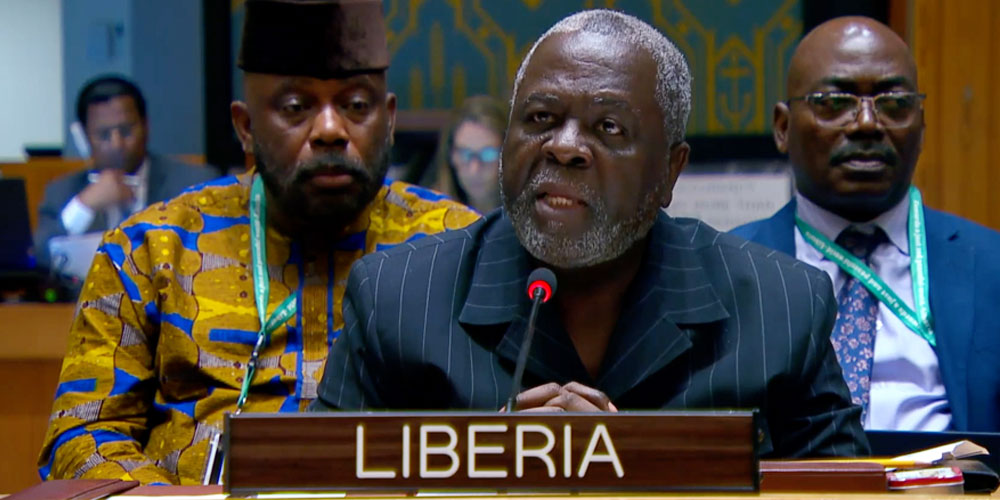
Delivered by H.E. Amb. Lewis G. Brown II, Permanent Representative of Liberia on Thursday, April 2, 2026 at the 10,128th Meeting of the UN Security Council
~~~~~
Thank you, Mr. President;
1. I join in welcoming Your Excellency to the Council Chambers, and in wishing success to Bahrain’s presidency.
Please be reassured of Liberia’s fullest cooperation.
We thank the Assistant Secretary-General to the United Nations, and the Secretary-General of the Gulf Cooperation Council, for their qualified briefings.
2. Mr. President, we meet at a moment when geography is no longer a buffer. It is, actually, a bridge over which crises travel faster than diplomacy, and across which regional tremors can quickly become global shocks. In such a challenging world, the promise of Chapter VIII of the Charter is the difference between reaction and prevention; between escalation of a conflict and its containment.
3. The partnership between the United Nations and regional organizations, including the Gulf Cooperation Council, reflects a simple truth: proximity breeds insight, and insight, when matched with global legitimacy, can produce effective action. As underscored by the briefers, regional actors bring contextual knowledge, political credibility, and the agility needed for early warning, mediation, and response.
4. In this regard, Liberia wishes to make the following points:
First: Regional collaboration must now move from affirmation to architecture. We do not need more declarations of partnerships. We need, as you indicated yourself Your Excellency, structured systems of partnership. This means, institutionalized information-sharing, joint analyses, and coordinated response mechanisms between the United Nations and regional bodies like the GCC.
The risks we face—from political tensions to transnational threats—are interconnected. Our responses, therefore, must be as well.
Second: Prevention must be the organizing principle of UN–GCC cooperation. The GCC’s proximity to emerging crises positions it as an early-warning asset. But early warning, without early action is merely early disappointment. The Council must empower and trust regional partners to act decisively in mediation and de-escalation, while ensuring coherence with international law and the UN Charter.
Third: Maritime Security is no longer a narrow technical issue—it is, in truth, a test of collective resolve. The security of strategic waterways, including the Strait of Hormuz, is integral to global stability. Disruptions to lawful transit are not regional inconveniences—they are global threats.
Strengthened UN–GCC cooperation in safeguarding these corridors must combine deterrence, diplomacy, and adherence to international law.
Fourth: Partnership must extend beyond crisis management to addressing root causes. As highlighted by the briefers, cross-cutting priorities—women, peace and security; youth, peace and security; tolerance; food and water security; as well as environmental pressures—are not peripheral issues. They are the fault lines along which future conflicts will certainly emerge. A UN–GCC partnership that invests in those areas is not just managing instability—it is preventing it.
Fifth: Burden-sharing must move from intention to action. The GCC has demonstrated capacity in mediation, humanitarian response, and development support, as we heard comprehensively from the Secretary-General. The United Nations must now match this with coordination, legitimacy, and strategic alignment.
Effective multilateralism is not about duplication; it is about division of labor grounded in comparative advantage.
Mr. President,
5. Liberia speaks from experience. We know what it means to emerge from conflict, and we know that peace is not delivered by distant actors alone. It is built through partnerships that combine local knowledge, regional engagement, and international support. In West Africa, collaboration between the United Nations and regional bodies has shown that those closest to the problem are often closest to the solution—if, however, they are empowered and supported.
6. But we have also learned that coordination gaps can be costly. Fragmented efforts delay peace. Competing mandates confuse it even further. And absent ownership certainly undermines it. The lesson, therefore, has to be clear-—partnerships must be deliberate, not incidental.
7. This is why we must guard against a false choice between regional action and global authority.
This is not a competition.
It is a complementarity, as speakers before me have pointed out.
The United Nations provides legitimacy; regional organizations provide immediacy.
Together, they provide effectiveness.
Finally, Mr. President;
8. To prevent the conflicts of tomorrow, we must strengthen the partnerships of today. The UN–GCC relationship offers a good template—not just for one region, but for a new model of cooperative security.
9. Let us build it, build upon it, strengthen it with clarity. Let us resource it with seriousness. And let us measure it not by the number of meetings we will hold, but by the number of conflicts we prevent.
I thank you.