
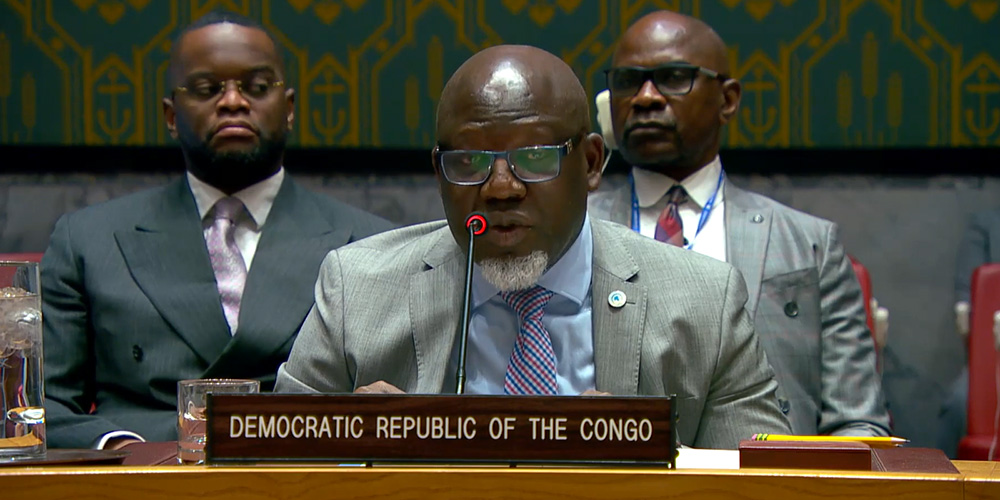
Delivered by Amb. Zenon Mukongo Ngay, Permanent Representative of the Democratic Republic of the Congo to the United Nations, at the 10,101st Meeting of the Security Council; UN HQ, New York | Wednesday, February 4, 2026:
Mr. President,
- I have the honor to deliver this statement on behalf of the A3, namely Liberia, Somalia, and my own country, the Democratic Republic of the Congo.
- The A3 would like to commend the exemplary leadership of the Somali Presidency for the effective, transparent, and able manner in which they have steered the Council's work in the month of January.
- We also congratulate the United Kingdom on assuming the Council presidency this month and welcome Your Excellency Mr. Chris Elmore, MP, Parliamentary Under-Secretary of State.
- At the outset, we thank UNOCT Acting Under-Secretary-General Zouev and Executive Director Gherman for their comprehensive briefings. We also take note of the SG’s twenty-second report on the threat posed by ISIL (Da’esh).
Mr. President,
- The report before us confirms a troubling reality: the threat posed by Da’esh has intensified steadily across multiple theatres, with a troubling shift towards the African continent. In West Africa and the Sahel, Da’esh affiliates are consolidating their presence and asserting control over territories. Same in northern Mozambique where Da’esh and its affiliates have widened their propaganda coverage and increased operational tempo this posing a continuous and substantial threat to populations.
- While we acknowledge the significant counter-terrorism successes in Iraq and Somalia that have led to all-time lows in attack frequencies, we cannot afford complacency. The group and its affiliates have shown an alarming capacity for adaptation, redirecting their strategies and resources to exploit instability and weak governance. This flexibility requires a response that is equally agile and unified, particularly for African nations that are now bearing the brunt of these threats. In light of these sobering developments, the A3 wishes to emphasize the following points:
- First, strengthening Regional and International Cooperation: Effective counter-terrorism requires both deep international cooperation and genuine national ownership. Somalia’s experience demonstrates the value of this approach. Through sustained counter-terrorism efforts by national security forces in conjunction with regional and international partners, the threat presented by Da’esh in Somalia has been significantly reduced, with a significant number killed during recent operations, over 180 arrested, and local fighters successfully reintegrating into their communities. This success underscores the critical importance of technical assistance, intelligence exchange, and sustained international partnerships.
- The A3 reaffirms that the African Union must remain central to the coordination of counter-terrorism efforts on the continent. We emphasize the need to strengthen the United Nations’ collaboration with the African Union and to leverage its distinctive expertise and deep-rooted experience. The African Union’s counter-terrorism initiatives, including the African Union Mechanism for Police Cooperation (AFRIPOL) and the Nouakchott and Djibouti Processes, are essential to continental and global counter-terrorism efforts.
- Second, addressing Root Causes and Prevention: A security-centered approach alone will not suffice. We must adopt comprehensive, whole-of-government and whole-of-society approaches that address the underlying drivers of radicalization, including poverty, lack of education, unemployment, political instability, and social exclusion that enable terrorism to take root.
- Sustainable development, coupled with targeted support for the most affected countries, remains our strongest defense against radicalization. We must invest in education, expand economic opportunities, and encourage civic participation, women, and women-led organizations in prevention and deradicalization activities. The inclusion of youth and women-led organizations in our prevention strategies is essential to build community resilience and diminish the pull factors of extremist ideologies.
- Third, responding to New and Emerging Technologies: We are alarmed by the increasing sophistication of Da’esh in utilizing new and emerging technologies. The group continues to enhance its capabilities through unmanned aircraft systems, which have enabled coordinated and simultaneous attacks across combat zones.
- Da’esh and its affiliates are also exploiting commercial satellite communication systems for low-cost, rapid, and relatively secure communications in remote areas. Virtual assets continue to be used to evade detection in financing terrorism, while Da’esh actively seeks to build cyber capabilities by appealing globally to cyber experts.
- We call for enhanced technical assistance and international cooperation to help African nations establish core capabilities to detect and disrupt these digital threats while ensuring all measures remain firmly grounded in international law, respect for human rights, and fundamental freedoms.
- Lastly, protection of Civilians and Respect for Human Rights: The protection of civilians, especially the most vulnerable populations, must remain at the heart of all counter-terrorism efforts. Our strategies must prioritize civilian safety while ensuring that counter-terrorism measures do not inadvertently create additional grievances that terrorist groups might exploit.
- All counter-terrorism efforts must be comprehensive, firmly rooted in the rule of law, and fully compliant with international human rights norms, international humanitarian law, and the guiding tenets of the UN Charter. We must also address the dangerous trend of counter-terrorism policies that unfairly single out particular communities or religions, which only serve to fuel division and undermine our collective efforts.
In conclusion, Mr. President,
- The fight against Da’esh and terrorism in all its forms and manifestations is a universal challenge that respects no borders and requires our sustained dedication, strengthened cooperation, and unwavering resolve. The gravity of the situation in Africa demands that regional Member States exercise political ownership to forge unified, coherent, and joint responses to these critical challenges.
- The success of our collective efforts depends on maintaining a delicate balance between robust security measures and the unwavering protection of human rights and the rule of law. The true measure of our success lies in our commitment to comprehensive approaches that reflect and uphold the foundational principles of peace, dignity, and justice that define our international community.
- The A3 remains committed to working with this Council and the broader international community to achieve a world free from the scourge of terrorism.
I thank you.