
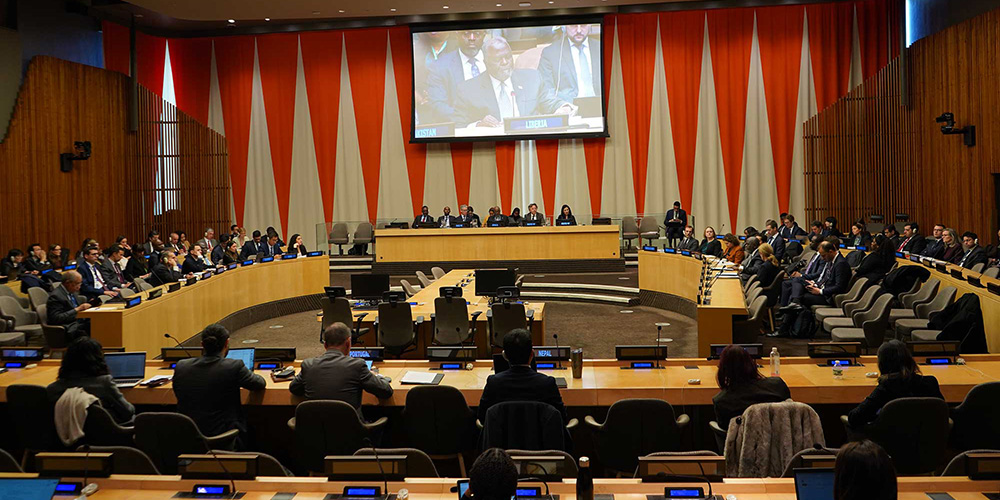
A Statement by Amb. Lewis Brown at an Arria Formula Meeting on Peacebuilding Convened by the Federal Republic of Somalia on Monday, January 12, 2026: Thank you, Mr. Chair. Liberia appreciates Somalia’s initiative to focus this discussion on how peace is actually built in real communities, not only negotiated in conference rooms.
For us, this is not theory. It is lived experience. Liberia comes to this conversation shaped by two decades of transition from war to peace. Our journey—from the 2003 Comprehensive Peace Agreement to today—has taught us a simple truth: a peace agreement is not peace. Peace has to be made and remade every day in homes, markets, villages, and institutions. When processes are remote, elite-driven, or detached from people’s realities, they do not last.
We have also learned that mistrust does not disappear automatically after guns fall silent. It lingers in land disputes, grievances, and perceptions of exclusion. And when people feel unheard, conflict can return in quieter but equally destructive forms.
Mr. Chair,
In Liberia, inclusion is not a slogan; it has been a survival strategy. Women’s groups, youth leaders, religious actors, and traditional authorities were not spectators to peacebuilding—they were builders of it. Community peace huts, local mediation structures, and the Palava Hut system provided safe spaces where people could speak, forgive, and resolve disputes without violence. These mechanisms—simple, local, and culturally grounded—often succeeded where formal processes stalled.
Our Truth and Reconciliation Commission (TRC) showed us both the power and limits of national truth-telling. Its work exposed painful histories, lifted up victims’ voices, and underscored the need for accountability and healing. One key lesson remains clear: truth without follow-through weakens confidence. Peacebuilding must connect acknowledgement to concrete reforms, especially in justice and governance.
Liberia’s ongoing decentralization efforts have likewise taught us that peace is closely tied to how power, services, and resources are shared. When decisions move closer to communities, participation deepens and frustration cools. Strengthening local government is therefore not just administrative reform—it is conflict prevention.
Land is one of the most sensitive issues in post-conflict societies. In Liberia, land dispute resolution mechanisms, including community-based mediation, have reduced tensions that once fueled violence. Integrating customary authorities and formal institutions has proven essential to legitimacy and compliance.
Mr. Chair,
Today’s conflicts are messy and long-lasting because they are rooted in social fractures, inequality, and exclusion. This means that checklist peace agreements and elite-only negotiations are no longer enough. Processes must be grounded in communities’ lived experience, designed with women and young people fully at the table from the beginning—not invited after decisions are already made.
Peacebuilding also works best when local efforts and regional initiatives reinforce one another. As an African country, Liberia values cooperation with the African Union and sub-regional organizations not as a slogan, but because our neighbors’ stability is our own.
Finally, peacebuilding cannot be compartmentalized. Justice, governance reform, livelihood opportunities, and social cohesion rise or fall together. Evidence from the field—not only from reports—should shape mandates, mediation efforts, and funding priorities.
In closing, Liberia will continue to champion people-centered, accountable, and locally rooted approaches to peacebuilding. The lesson from our own story is clear: peace endures when citizens recognize themselves in the process.
I thank you.