
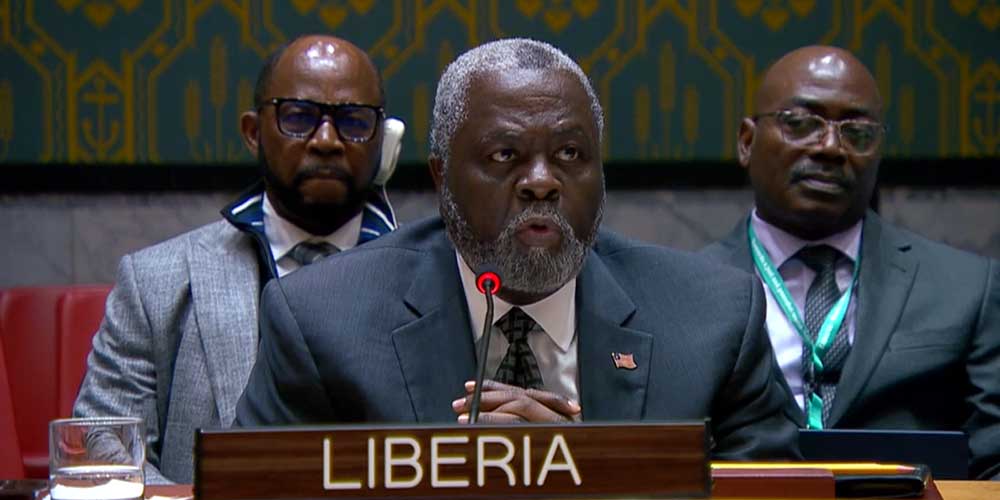
A Statement by Amb. Brown at the Security Council Open Debate on the Rule of Law, Organized by the Federal Republic of Somalia \ Liberia thanks Somalia for convening this debate and the distinguished briefers for their insightful contributions. Mr. President, Excellencies:
- We are meeting at a time when the international legal order, the foundation of multilateralism is being tested not by the absence of rules, but by uncertainty in application. The question before us is not whether international law exists. It is whether it still governs conduct when it matters most.
- For Liberia, the rule of law is practical, not ornamental. It governs conduct. It allocates responsibility. By producing consequences, it serves as a guarantor of peace and security. Guiding the interaction among states, international law is the architecture that makes peaceful coexistence possible in a system of unequal powers allowing sovereignty to be more than a declaration, and peace to be more than a pause between conflicts.
- Liberia was present in San Francisco in 1945 when this all began - one of only four African countries. Liberia has the credibility to say: the Charter of the United Nations was drafted with clarity of purpose. It did not promise convenience. It promised restraint. It did not privilege power. It disciplines it. Its obligations are not optional, and its principles were never intended to apply selectively.
- The Charter assumes something fundamental: that peace cannot be sustained if rules are treated as discretionary, or if commitments are honored only when aligned with immediate interests. It places responsibility where it belongs - on all States, without distinction recognizing that influence brings obligation, not exemption.
Mr. President,
- The credibility of the international system depends on consistency. When international law is invoked in one context and disregarded in another, trust erodes—not only in specific outcomes, but in the system itself. Over time, this weakens deterrence, fuels grievance, and erodes the predictability on which international peace and security depend.
- Africa’s recent experience offers a different path. Across the continent, States have increasingly turned to judicial and arbitral mechanisms to resolve boundary and maritime disputes. These decisions have not always been easy, but they have been respected. They have prevented escalation. They have demonstrated that law, when used, works.
- Yet, these gains are fragile. Confidence falters when access to justice appears uneven, when accountability is constrained, or when compliance becomes negotiable. A system perceived as unequal cannot command lasting respect.
- There is an African proverb that captures the stakes: when the elephants fight, it is the grass that suffers. Today, the grass is suffering - civilians in conflict zones, smaller States navigating geopolitical rivalries, and communities bearing the consequences of decisions taken too far from them. The erosion of legal restraint does not remain abstract; it produces human cost.
Mr. President, Excellencies:
- Peace is not sustained by declarations alone. It is sustained by conduct - predictable, restrained, and consistent with agreed rules. The Charter provides tools for this purpose, including negotiation, mediation, arbitration, judicial settlement, and regional arrangements. These mechanisms are not signs of weakness. They are safeguards against escalation and insecurity.
- When they are bypassed, ignored, or applied unevenly, the Council’s preventive capacity diminishes. Liberia believes the Security Council can restore confidence and reinvigorate multilateralism by acting with greater discipline in three areas:
- First, by affirming—clearly and consistently—the binding character of international judicial decisions and encouraging their use as instruments of prevention, not last resort.
- Second, by strengthening operational coherence between the Council and regional mechanisms, particularly in Africa, so that political engagement, mediation, and legal processes reinforce rather than undercut one another.
- Third, by exercising restraint and consistency in the interpretation and implementation of Charter obligations, ensuring that Council action reflects principles, not expediency.
Mr. President,
- This year marks eighty years since the adoption of the United Nations Charter. The Charter’s relevance has not diminished. What is at issue is fidelity to it. If we want a system governed by law rather than leverage, then adherence must be uniform. If we want peace that lasts, then justice cannot be selectively applied. And if multilateralism is to remain credible, then this Council must lead by example.
- The choice before us is not between law and politics. It is whether politics will continue to be guided by law.
- I thank you.